

Being admitted to hospital in France can feel daunting when French isn’t your first language. From your Carte Vitale and mutuelle to hospital costs, discharge and getting home, here’s what you need to know.
Being admitted to hospital is unsettling enough without also having to navigate an unfamiliar healthcare system in another language.
If you are admitted to hospital in France, you may suddenly find yourself hearing unfamiliar terminology, being handed paperwork you don’t understand and wondering what your Carte Vitale actually covers.
Do you need to contact your mutuelle? Will you receive a bill? What happens to your regular medication? Who organises care when you go home? And what if you live alone and have nobody nearby to help?
The good news is that you don’t need to understand the whole French hospital system.
You just need to know what to expect, what to check and, importantly, what questions to ask.
How Are You Admitted to Hospital in France?
A hospital admission can be planned or unexpected.
You might be admitted following a consultation with your GP or specialist, attend for planned surgery or treatment, have a day-case procedure, or arrive through les urgences — the emergency department.
For planned treatment, the hospital or clinic will normally give you information beforehand about where to go, when to arrive and any preparation required.
Outside an emergency, patients can generally choose between public hospitals and private healthcare establishments. However, costs and reimbursement can differ, particularly with private establishments and practitioners charging fees above the official Assurance Maladie tariff.
For planned treatment, don’t be afraid to ask about this beforehand.
“What will I have to pay?” is a perfectly reasonable question.
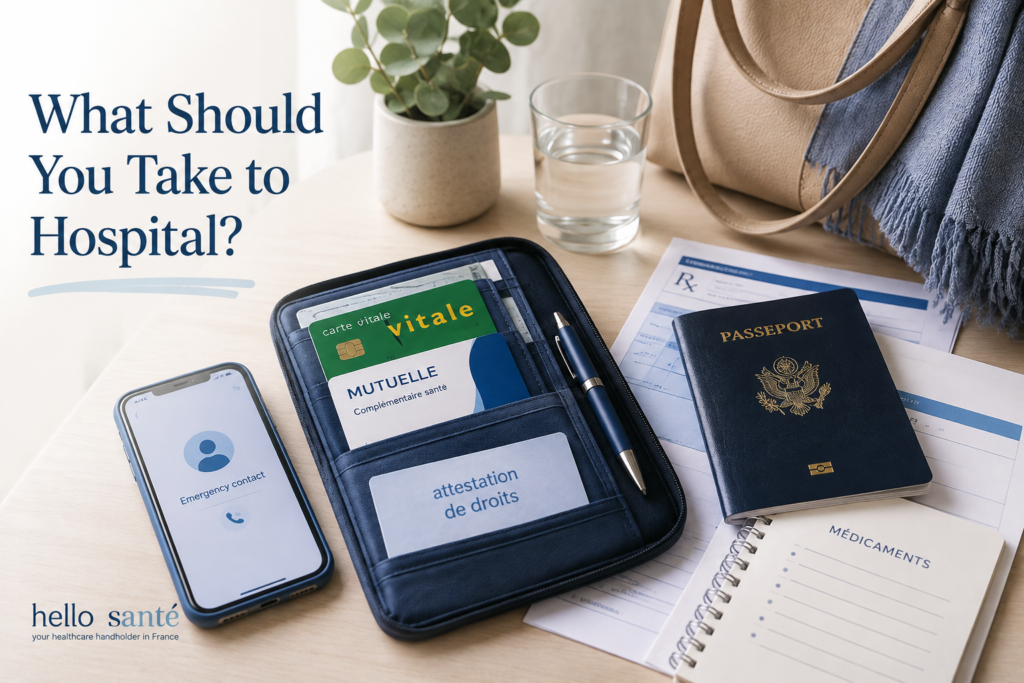
What Should You Take to Hospital?
For a planned admission, a little preparation can make the administrative side considerably easier.
I would suggest having the following together:
- your Carte Vitale, or an attestation de droits showing your Assurance Maladie entitlement;
- your mutuelle card or certificate, if you have complementary health insurance;
- a passport, identity card or other accepted identification;
- an up-to-date list of your medication and dosages;
- current prescriptions;
- any medical letters, test results or other documents the hospital has asked you to bring;
- contact details for the person you would like contacted if necessary.
One thing that sometimes surprises people is that your Carte Vitale is not an identity document. The hospital may therefore ask for both your Carte Vitale and proof of identity.
And if you don’t have your Carte Vitale with you, don’t assume that means you cannot receive treatment. Your healthcare rights can also be demonstrated with an attestation de droits.
Your Carte Vitale Doesn’t Necessarily Mean Everything Is Free
This is an important point.
Having a Carte Vitale and being covered by Assurance Maladie does not automatically mean that your hospital stay will cost you nothing.
For treatment in a public hospital or private establishment conventionné, Assurance Maladie generally covers 80% of eligible hospital costs, although there are circumstances in which coverage can be higher or at 100% of the official reimbursement basis.
There may then be an amount remaining for you to pay.
Your mutuelle may cover some or all of this, depending on your contract.
There can also be other charges, including the forfait hospitalier, additional specialist fees and optional extras such as a private room.
This is where people often become confused. There isn’t necessarily one single answer to the question, “How much does a hospital stay cost?”
It depends on your treatment, circumstances, hospital, doctors and complementary cover.
The Forfait Hospitalier: One Cost Worth Knowing About
If you stay in hospital, you may hear the term forfait hospitalier.
This is a daily contribution towards the accommodation costs associated with hospitalisation.
As of 1 March 2026, the standard forfait hospitalier is €23 per day in a hospital or clinic and €17 per day in a psychiatric department.
It is not reimbursed by Assurance Maladie itself.
Many mutuelle policies cover it, and certain patients are exempt, but don’t simply assume that yours does.
If your hospital stay is planned, check your policy or contact your mutuelle beforehand.
It’s much nicer to discover what you’re covered for before admission than when a bill arrives afterwards.
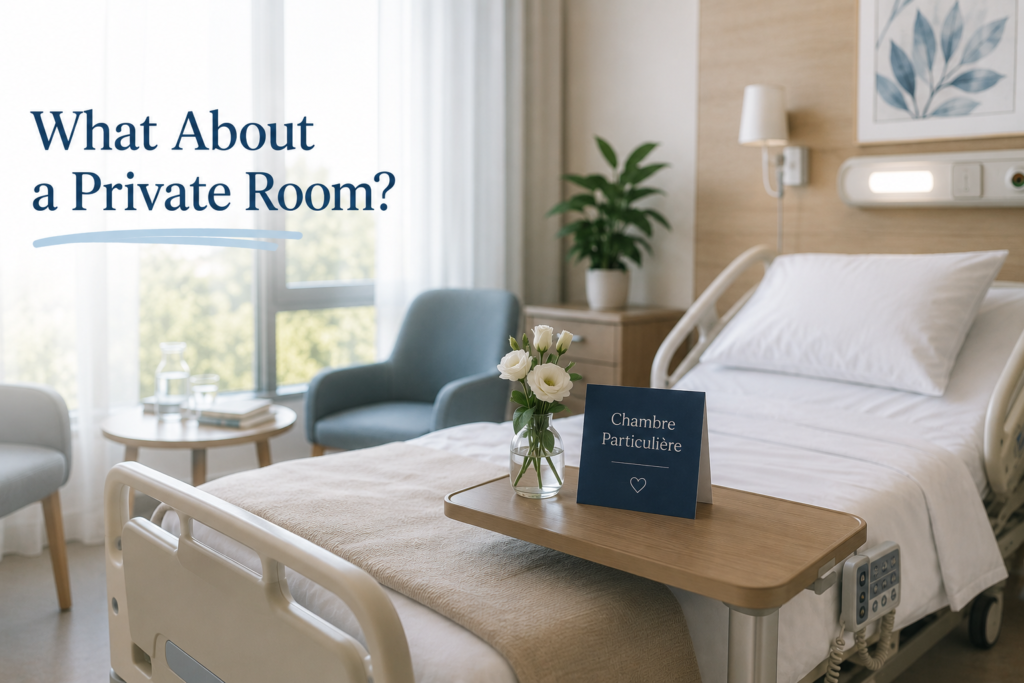
What About a Private Room?
A chambre particulière — private room — is generally an additional comfort rather than standard medical care.
If you request one, there may be a daily charge.
Some mutuelles provide generous private-room cover. Others set a daily limit or restrict the number of days covered, and some may not cover it at all.
So if someone asks whether you would like a private room, don’t assume it is included simply because you have a mutuelle.
Ask:
How much does it cost per day?
Then check what your mutuelle will reimburse.
Watch Out for Dépassements d’Honoraires
Another potential source of unexpected costs is dépassements d’honoraires.
These are fees charged above the official tariff used as the basis for Assurance Maladie reimbursement.
They can arise with certain surgeons, anaesthetists and other specialists, particularly in private healthcare settings.
Assurance Maladie does not reimburse the amount above its official reimbursement basis. Your mutuelle may cover some or all of these additional fees, depending on the level of your policy.
For planned treatment, ask about fees in advance and obtain a devis where appropriate.
If you are handed a quotation full of unfamiliar percentages and terminology, don’t be embarrassed to ask somebody to explain it before you agree.
This Is Where Your Mutuelle Really Matters
People often think about their mutuelle in terms of everyday doctor and pharmacy reimbursements.
Hospitalisation is one of the times when you may really discover what your policy does — and doesn’t — cover.
Depending on your contract, your mutuelle may contribute towards:
- the portion of eligible hospital costs remaining after Assurance Maladie;
- the forfait hospitalier;
- some dépassements d’honoraires;
- a private room;
- certain additional services.
If your admission is planned, contact your mutuelle beforehand.
Ask specifically about hospitalisation, rather than simply asking whether you are “covered”.
If the admission happens unexpectedly, don’t worry about sorting insurance administration while you are acutely unwell. Once the immediate situation is under control, you or someone helping you can contact the mutuelle and hospital administration.
What Happens If You Are Admitted Through Urgences?
If you arrive through les urgences, your immediate medical needs take priority.
The paperwork can follow.
If you are alone, very unwell or unable to deal with the administrative side yourself, tell the hospital staff.
If possible, a partner, friend or family member can bring your identification, Carte Vitale and mutuelle information later.
And if French isn’t your first language, say so.
This is not the moment to nod politely because you’re embarrassed about asking somebody to repeat themselves.
If someone is explaining your diagnosis, treatment, consent to a procedure or what will happen next, you need to understand as well as reasonably possible.
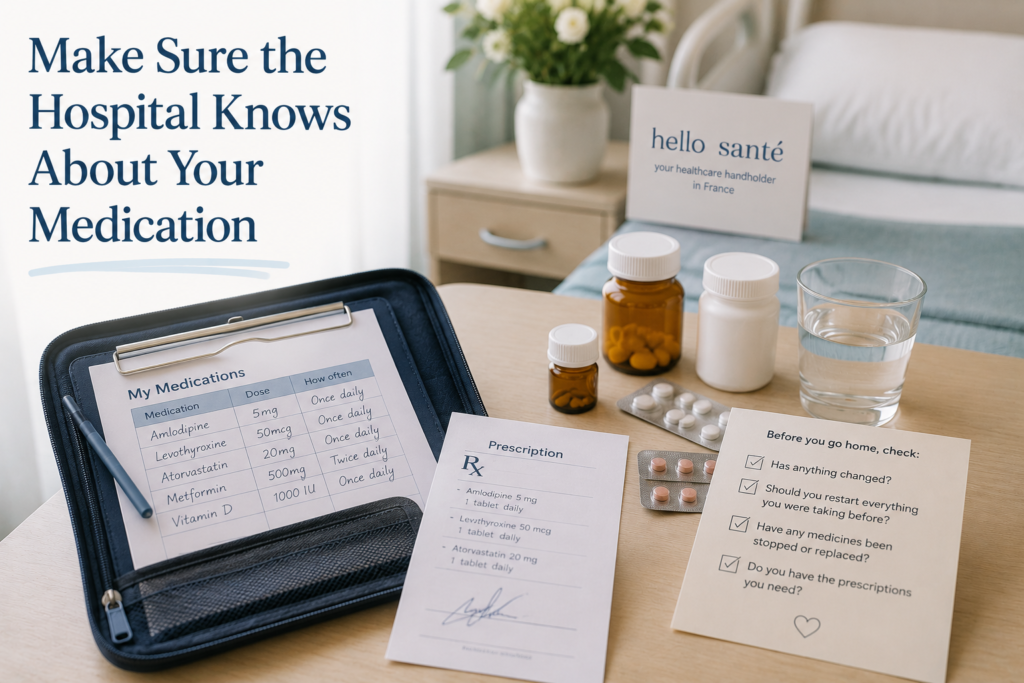
Make Sure the Hospital Knows About Your Medication
If you take regular medication, bring an up-to-date list showing the names, doses and how often you take them.
A copy of your current prescription can also be extremely useful.
Don’t automatically continue taking medication you brought from home without discussing it with the hospital team. During your stay, your treatment may need to be changed, temporarily stopped or supplied differently.
And before you go home, check again.
Has anything changed?
Should you restart everything you were taking before?
Have any medicines been stopped or replaced?
Do you have the prescriptions you need?
Medication changes made during a hospital stay are exactly the sort of detail that can become confusing once you’re back home.
Don’t Be Afraid to Ask Questions
French hospital terminology can be difficult even for people who speak good French.
When you’re tired, frightened, in pain or taking medication, processing another language can become harder still.
Write down your questions.
Some useful ones are:
What happens next?
Why am I having this test or treatment?
Has my medication changed?
When will I get the results?
Will I need a follow-up appointment?
Is somebody arranging that appointment, or do I need to do it myself?
Will I need help when I go home?
That last question is particularly important.
Never assume that because somebody has mentioned a nurse, physiotherapist or follow-up appointment, it has automatically been organised.
Ask.
If You’re on Your Own in France
This deserves a section of its own because many international residents don’t have family living nearby.
If you live alone, tell the hospital team.
If you’re worried that you won’t be able to cook, wash, move around safely, collect medication or manage stairs when you return home, mention it before discharge.
Don’t wait until you’re dressed, holding your bags and standing at the hospital exit to say that you don’t know how you’re going to cope.
Depending on your medical and personal circumstances, the hospital team can assess what follow-up or support may be appropriate.
There may not be a solution for every practical difficulty, but staff can’t take your circumstances into account if they don’t know about them.
What Happens When You Leave Hospital?
Discharge in France is known as la sortie.
This is one of the stages where I would encourage you not to rush.
You may be relieved to be going home, but don’t walk out of the hospital with a pile of papers you don’t understand.
Depending on your circumstances, you may receive prescriptions, discharge documentation, information about follow-up appointments, instructions for wound care or rehabilitation, and employment-related paperwork.
A bon de sortie is also issued and may need to be sent to your Assurance Maladie caisse where required.
Before leaving, establish:
- what medication you should now take;
- whether anything has changed;
- whether you need a GP or specialist follow-up;
- whether blood tests, scans or other examinations are required;
- whether nursing care is needed at home;
- whether physiotherapy or rehabilitation has been prescribed;
- whether those services have actually been arranged;
- what symptoms should prompt you to seek further medical attention;
- who you should contact if you have a problem.
And ask one particularly useful question:
“Is there anything I need to organise myself?”
That one question can prevent a lot of confusion.
Once you’re home, finding the right person to ask can suddenly become much harder.
What If You Need Healthcare at Home?
Leaving hospital doesn’t necessarily mean your healthcare stops at the hospital door.
Depending on your condition, you may need follow-up from community healthcare professionals, such as a nurse or physiotherapist.
For some patients who meet the medical criteria, hospitalisation à domicile (HAD) allows hospital-level treatment to be provided at home as part of an organised care programme.
Some patients may also be eligible for Prado, an Assurance Maladie service designed to help with the transition between hospital and appropriate community care following certain hospitalisations.
The important thing is not to assume.
Ask the hospital team:
What is being organised for me, and what do I need to arrange myself?
What If You Can’t Get Home by Yourself?
Medical transport is another part of French healthcare that frequently causes confusion.
Depending on your medical condition, a doctor may prescribe appropriate transport for admission, discharge or certain ongoing treatments.
This might involve an ambulance, a véhicule sanitaire léger (VSL), a taxi conventionné or another appropriate form of transport.
Hospital-related transport can be reimbursed by Assurance Maladie when the relevant conditions are met.
But this is important:
Don’t simply book an ambulance or ordinary taxi and assume Assurance Maladie will reimburse it.
If medical transport is necessary, ask whether you need a prescription médicale de transport and which type of transport has been prescribed.
The type of vehicle isn’t simply a matter of preference; it should reflect your medical needs and the reimbursement rules.
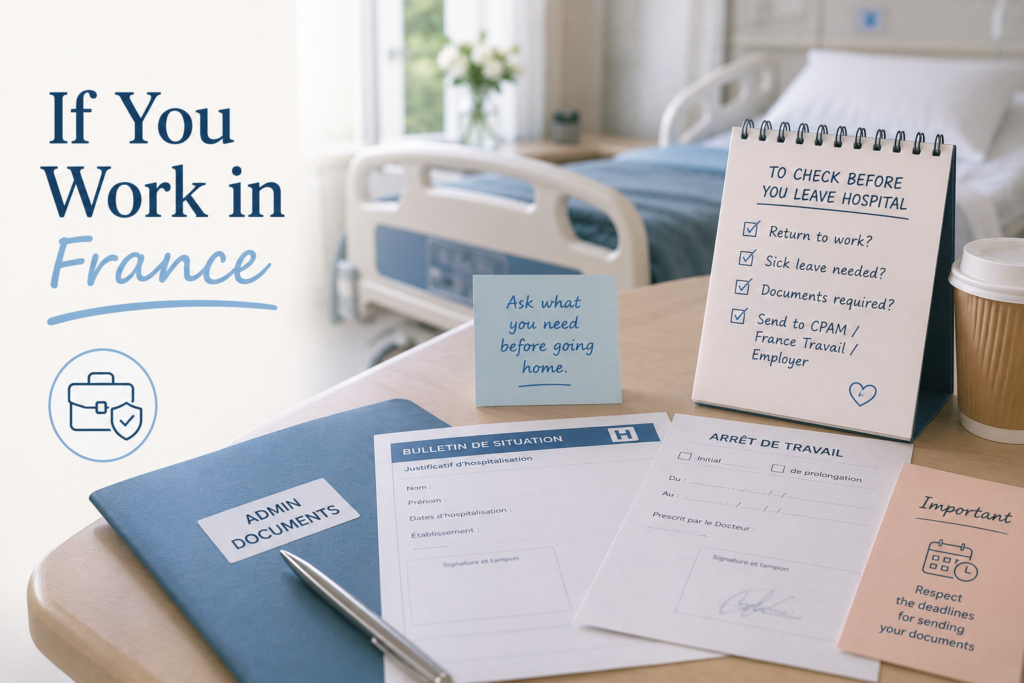
If You Work in France
If you are employed or registered with France Travail, don’t forget the administrative consequences of hospitalisation.
During your stay, the hospital’s bulletin de situation can serve as evidence of your hospitalisation and, where applicable, as a work-stoppage document.
Relevant documents need to be sent within the required deadlines to the appropriate organisations.
And this is something worth checking before you leave hospital:
If you aren’t medically fit to return to work after discharge, the hospital stay itself doesn’t automatically provide ongoing sick-leave cover indefinitely. You may need an arrêt de travail covering the period after discharge, issued as appropriate by a hospital doctor or your GP.
Ask what you need before going home rather than discovering several days later that paperwork is missing.
When French Isn’t Your First Language
Being ill has a strange way of making vocabulary disappear.
You may normally manage perfectly well in French and then find yourself unable to remember the simplest word when someone in a white coat is explaining something important.
That’s normal.
Ask people to slow down.
Ask them to repeat themselves.
Ask for important information in writing where possible.
Take photographs or copies of paperwork you are given and keep it together.
If a trusted friend or family member can help you communicate or understand the administration, accept their help.
You do not get extra points for navigating a French hospital alone.
Sometimes having another person there simply means there are two pairs of ears listening instead of one.
Before a Planned Hospital Stay: A Little Preparation Helps
If you know you’re going into hospital, there are a few things worth doing beforehand.
Check that your Assurance Maladie rights and Carte Vitale information are up to date.
Check your mutuelle cover specifically for hospitalisation, including the forfait hospitalier, private rooms and dépassements d’honoraires.
Prepare an accurate medication list.
Put your important documents together.
Think about how you will get home.
If you live alone, consider what you might need during the first few days after discharge.
And write down your questions before you go.
When you’re sitting in a hospital gown waiting for a procedure, it isn’t always easy to remember the list you had perfectly organised in your head the night before.
Hello Santé — In Closing
If there’s one thing I would like English speakers to take from this guide, it’s that you don’t have to become an expert in French hospital administration.
You just need to know enough to ask the right questions.
What am I being charged for?
What does my mutuelle cover?
Has my medication changed?
Who is arranging my follow-up care?
Is there anything I need to organise myself?
And what happens when I get home?
Being admitted to hospital can make anyone feel vulnerable. Add another language, unfamiliar paperwork and a healthcare system you didn’t grow up with, and it’s understandable that things can become overwhelming.
Take it one step at a time.
Ask when you don’t understand. Keep your paperwork. Accept help when it is offered. And before you leave hospital, make sure you know what happens next.
My work as a healthcare handholder is about helping English speakers navigate exactly these moments — when the French healthcare system feels complicated, the language becomes a barrier or you simply don’t know which question to ask.
Sometimes a little guidance at the right moment can make an enormous difference.