What does a Carte Vitale actually do? Who can get one, how do you apply, what happens if you forget or lose it, and does it mean your healthcare is free? Here’s what English speakers living in France need to know.
If you live in France, there is one little green card you will hear about again and again: the Carte Vitale.
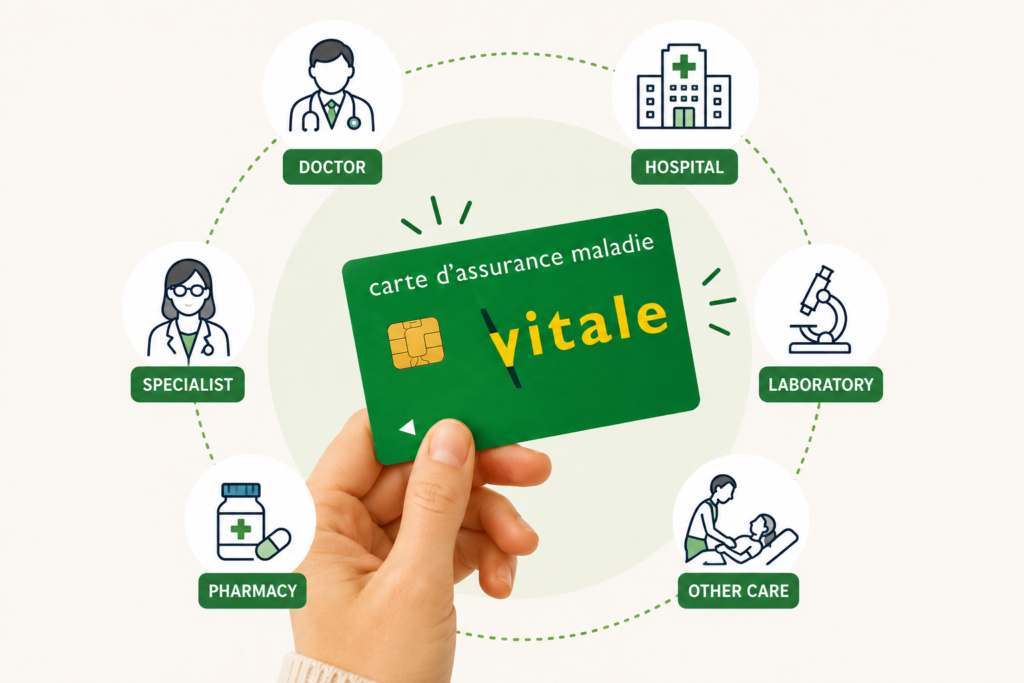
At the doctor.
At the pharmacy.
At the hospital.
At the laboratory.
And probably in several conversations with CPAM along the way.
But one of the things I regularly find is that people have a Carte Vitale without really understanding what it does — and, just as importantly, what it doesn’t do.
Does having one mean you have French healthcare?
Does it pay for your treatment?
Is it the same as a mutuelle?
What happens if you don’t have it with you?
Can your partner use yours?
Do you need to renew it?
And what about the new digital Carte Vitale on your phone?
Let’s clear it up.
What Is a Carte Vitale?
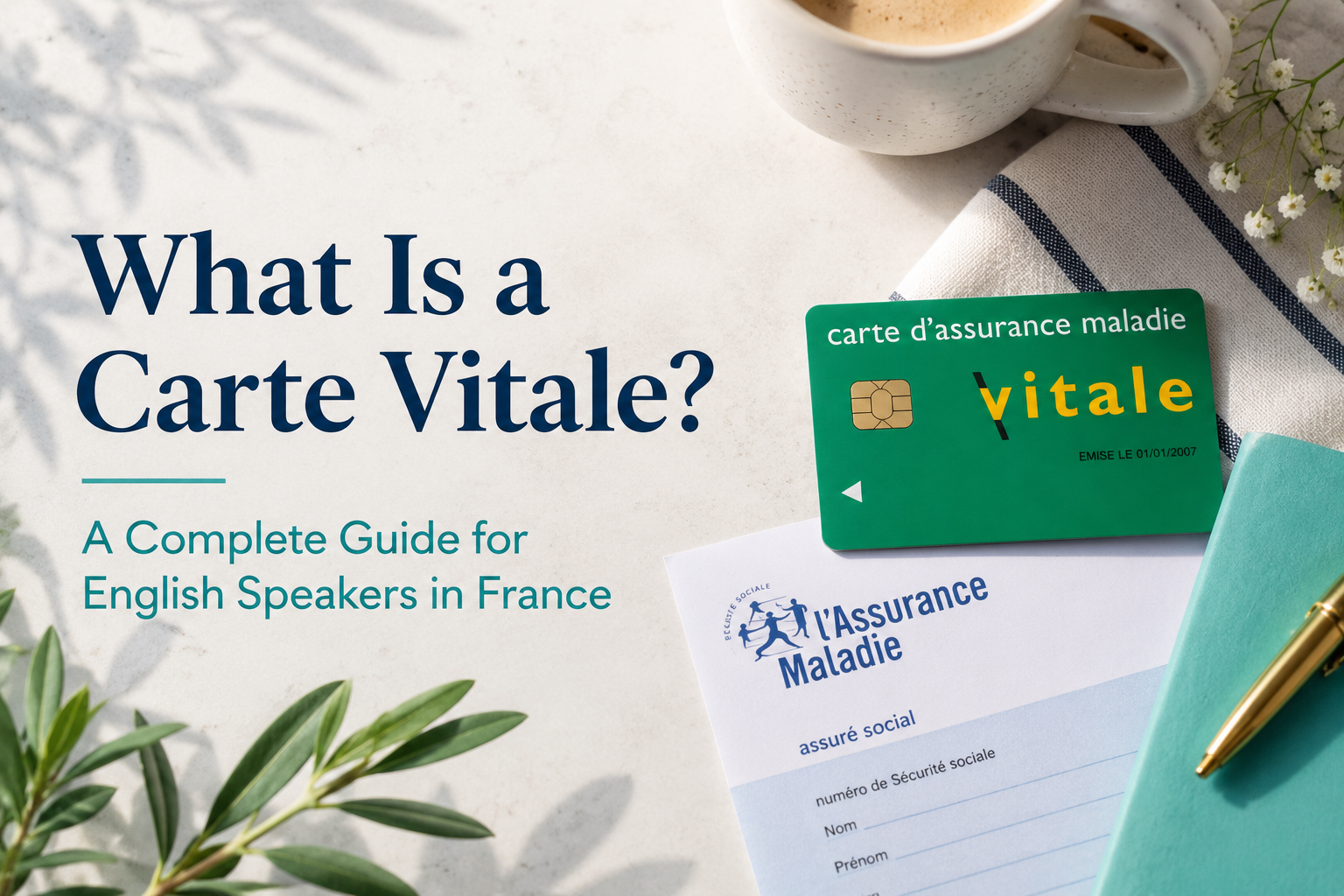
The Carte Vitale is your French health insurance card.
It shows that you are registered with the French health insurance system and gives healthcare professionals access to the administrative information they need to process eligible healthcare reimbursements.
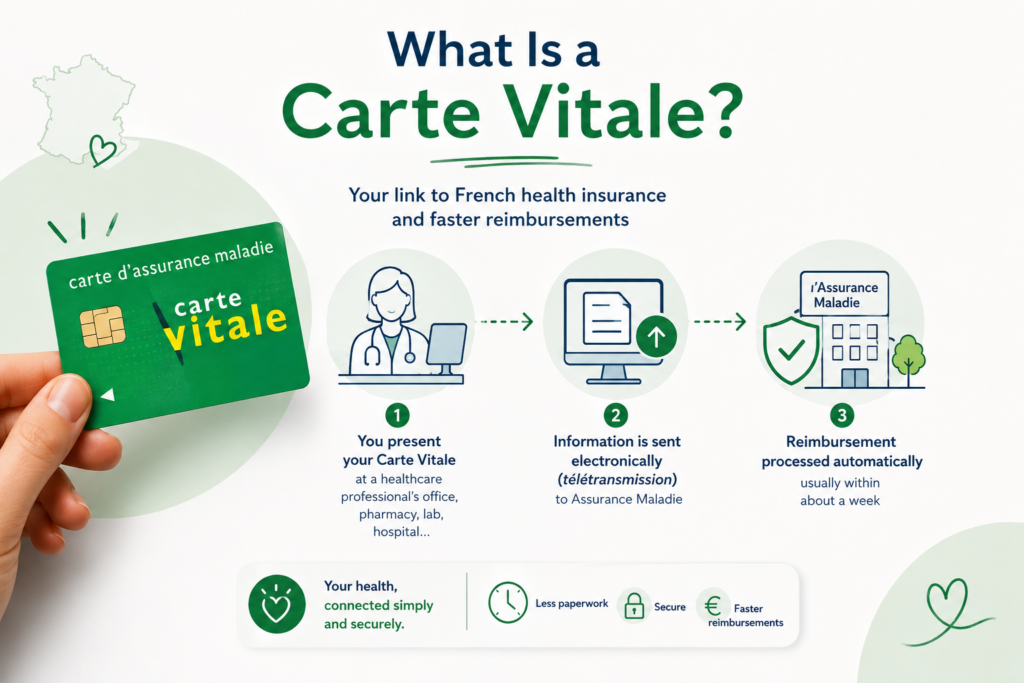
When you present your Carte Vitale to a healthcare professional equipped to use it, information about your treatment can normally be transmitted electronically to Assurance Maladie.
This is known as télétransmission.
Instead of you completing a paper feuille de soins and sending it to your health insurance caisse, the information is transmitted electronically.
Assurance Maladie states that using the Carte Vitale allows reimbursement to be processed automatically, normally within about a week.
In everyday terms, think of your Carte Vitale as the card that connects your healthcare treatment with your French health insurance record.
But there is one very important distinction.
A Carte Vitale Is Not a Payment Card
This is probably the biggest misunderstanding worth clearing up.
Your Carte Vitale is not a bank card, and presenting it does not necessarily mean you won’t have to pay.
You may still be asked to pay the doctor, specialist, dentist, physiotherapist, laboratory or other healthcare professional.
Your Carte Vitale allows the information required for reimbursement to be transmitted to Assurance Maladie.
What happens financially depends on the treatment, the healthcare professional, the official reimbursement basis, your individual circumstances and whether tiers payant applies.
So:
Carte Vitale = healthcare administration and reimbursement information.
It does not simply mean:
Carte Vitale = free healthcare.
That distinction will save you a great deal of confusion.
Does Having a Carte Vitale Mean All Your Healthcare Is Free?
No.
France does not generally operate on the basis that every healthcare expense is automatically paid in full simply because you have a Carte Vitale.
Assurance Maladie reimburses healthcare according to French reimbursement rules.
Depending on the treatment and your circumstances, there may be an amount left for you to pay.
This is one reason many people in France also have complementary health insurance — a mutuelle.
Your Carte Vitale and your mutuelle are therefore not the same thing.
Carte Vitale vs Mutuelle: What’s the Difference?
This is another area where newcomers understandably become confused.
Your Carte Vitale relates to your statutory French health insurance rights.
Your mutuelle is complementary health insurance that may cover some or all of certain healthcare costs remaining after Assurance Maladie, depending on your contract.
In many cases, your mutuelle can be electronically linked to your Assurance Maladie record so that reimbursement information passes on automatically.
You may hear this referred to as NOÉMIE télétransmission.
When everything is correctly connected, the process can feel almost invisible: Assurance Maladie processes its part and the relevant information is then transmitted to your complementary insurer.
But don’t assume that owning a Carte Vitale means you automatically have a mutuelle.
They are two different things.
Who Can Get a Carte Vitale?
To obtain a Carte Vitale, you need to be registered with the French social security system, have a social security number and have healthcare rights open with the relevant French health insurance organisation.
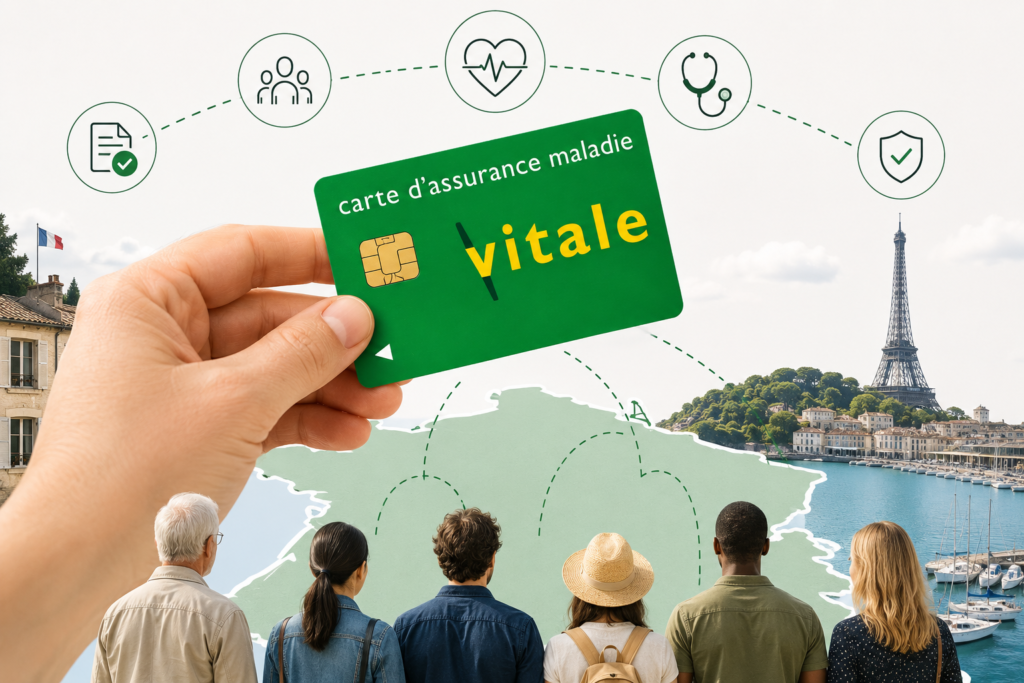
The Carte Vitale is available to eligible insured people regardless of whether they were born in France or moved here from another country.
This is particularly important for the people I work with.
You do not have to be French to have a Carte Vitale.
If you have moved to France from the UK, United States or elsewhere, your first challenge is therefore not really “getting a Carte Vitale”.
The first step is establishing your entitlement and becoming correctly registered with the French healthcare system.
Once your rights are established and the necessary registration is in place, the Carte Vitale follows from that process.
Do I Need a Permanent French Social Security Number First?
The Carte Vitale is linked to your French social security registration.
People newly entering the French system may initially encounter a temporary social security number while their registration is being processed.
This is where I often encourage people to separate two things in their minds:
having healthcare rights and physically possessing a Carte Vitale are not necessarily the same thing.
There can be a period during the registration process when your healthcare rights exist but your physical card has not yet arrived.
Which brings us to an extremely useful document.
What Is an Attestation de Droits?
If you remember one French healthcare document besides your Carte Vitale, make it this one.
Your attestation de droits is your certificate of entitlement to French health insurance.
It confirms your healthcare rights and can be downloaded through your ameli account when available.
If you don’t yet have your Carte Vitale, are waiting for a replacement, or need to demonstrate your rights, your attestation de droits can be presented to healthcare professionals.
I often suggest keeping a recent copy somewhere accessible.
You don’t need to carry a filing cabinet around France with you, but having the document available on your phone can be extremely useful.
How Do You Apply for Your First Carte Vitale?
Once you are eligible and your registration allows you to order your card, a Carte Vitale can be ordered through your compte ameli.
The online process involves checking your personal details and supplying the requested identity documentation and photograph.
According to Assurance Maladie, when ordered online the card is normally received in approximately two weeks after the order has been processed.
And something very important:
A Carte Vitale is free.
You should not be paying a website or responding to a text message asking you to pay for a new Carte Vitale.
More on that later.
What Information Is Stored on a Carte Vitale?
The Carte Vitale contains the administrative information needed to identify you and process your healthcare rights and reimbursements.
It can include information connected with particular healthcare entitlements, such as maternity or certain affection de longue durée (ALD) rights.
It is not, however, simply a portable copy of your entire medical history.
People sometimes imagine that when a doctor inserts a Carte Vitale into a reader, every doctor in France can suddenly see everything that has ever happened to them medically.
That isn’t what the Carte Vitale is for.
It is primarily part of the administrative and reimbursement process.
Don’t confuse it with Mon espace santé, France’s digital health space, which has a different purpose.
Should I Give My Carte Vitale to Every Healthcare Professional?
As a general rule, take it with you whenever you access healthcare.
That includes visits to your GP, specialists, pharmacies, hospitals, laboratories and other healthcare professionals who use the Carte Vitale system.
Presenting it allows the healthcare professional to transmit the relevant feuille de soins electronically where their system permits it.
My practical advice is simple:
If you’re going somewhere healthcare-related, take your Carte Vitale.
It is much easier than wondering whether you’re going to need it.
What Happens If I Forget My Carte Vitale?
Don’t panic.
Forgetting your Carte Vitale doesn’t suddenly mean you have lost your French healthcare rights.
Your rights and the physical card are not the same thing.
Depending on the healthcare professional and circumstances, you may need to provide your attestation de droits, and the reimbursement process may need to be handled differently.
In some situations, you may receive a paper feuille de soins that needs to be dealt with manually rather than having everything transmitted electronically.
It may be less convenient, but forgetting your card does not erase your entitlement to healthcare.
What Is a Feuille de Soins?
A feuille de soins is a healthcare reimbursement form.
Before electronic transmission became standard, these paper forms were a normal part of getting reimbursed.
You may still encounter one if electronic transmission cannot be used — for example, because your Carte Vitale isn’t available or the healthcare professional cannot process it electronically.
If you receive one, don’t throw it away.
It may be what you need to obtain your Assurance Maladie reimbursement.
Do I Have to Update My Carte Vitale?
Yes.
This is one of those tiny French healthcare jobs that’s very easy to forget.
Assurance Maladie recommends updating your physical Carte Vitale at least once a year and after changes in your circumstances.
That could include changes relating to your address, family situation or healthcare rights.
The actual update can be carried out at terminals available in most pharmacies and certain Assurance Maladie locations.
It normally takes very little time.
One easy habit is to choose the same month every year — your birthday month, for example — and make updating your Carte Vitale part of your routine.
And if CPAM has recently changed something important on your record, update the card afterwards so that the information held on it reflects your current rights.
I’ve Moved House. Does My Carte Vitale Update Automatically?
Not quite.
If your circumstances change, you first need to make sure the underlying information held by Assurance Maladie is correct.
Updating the physical card does not magically tell CPAM that you’ve moved or that your circumstances have changed.
Think of it this way:
First, tell the appropriate organisation about the change.
Then update your Carte Vitale so the card reflects the information held in the system.
Putting the card into a pharmacy terminal isn’t a substitute for reporting a change that CPAM doesn’t yet know about.
What Happens If My Carte Vitale Stops Working?
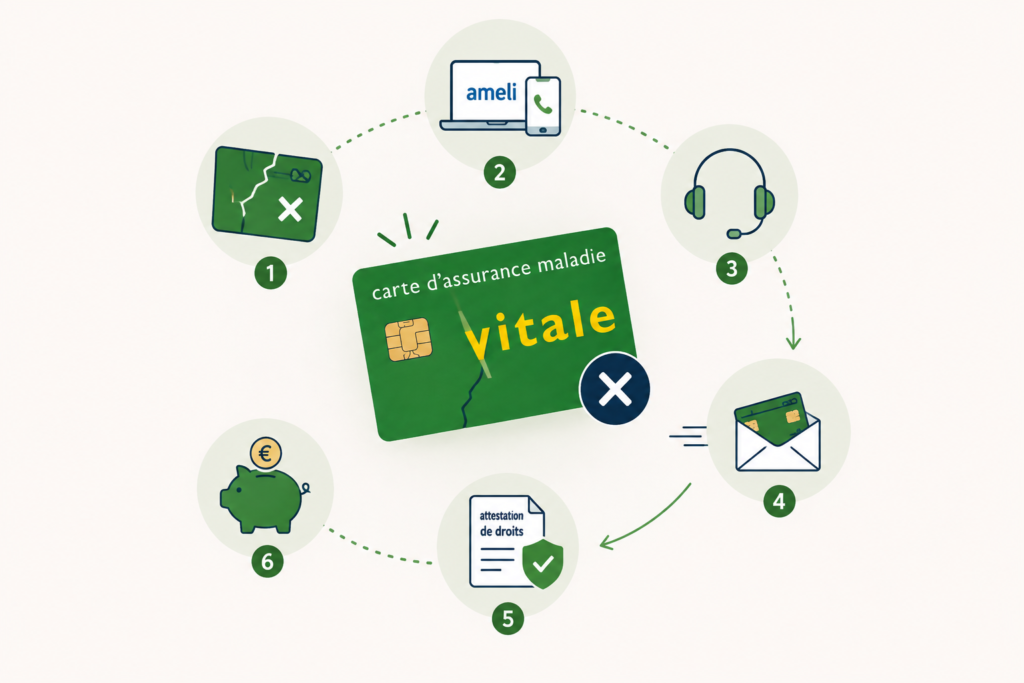
Cards can become damaged or the chip can stop being read correctly.
If your Carte Vitale is defective, report the problem to your health insurance caisse.
For people insured through the general Assurance Maladie system, this can be done through the ameli system or by contacting CPAM.
A replacement can then be ordered.
While you’re waiting, your attestation de droits is once again your useful backup.
Replacement following loss, theft or malfunction is free.
What Should I Do If My Carte Vitale Is Lost or Stolen?
Report it promptly.
You can declare a lost or stolen Carte Vitale through your ameli account or contact your health insurance caisse.
You can then order a replacement.
Again, there should be no charge for declaring the loss or theft and obtaining the replacement card through the official process.
Can My Partner Use My Carte Vitale?
No.
Your Carte Vitale is personal to you.
Your spouse or partner doesn’t simply borrow your card because you are married or live at the same address.
Adults who have their own French health insurance rights should use their own Carte Vitale.
Children are slightly different.
Children can be linked to their parents’ healthcare records, and Assurance Maladie recommends adding children to the Carte Vitale records of both parents, which can make healthcare considerably easier when either parent takes the child to an appointment.
Is the Carte Vitale an Identity Card?
No.
This is particularly worth remembering when you are admitted to hospital.
Your Carte Vitale is not an official identity document.
A hospital or other organisation may therefore ask you for both your Carte Vitale and an accepted identity document.
Don’t be surprised if presenting your green card isn’t enough to prove your identity.
Does the Carte Vitale Work Outside France?
This is an important distinction.
The Carte Vitale is for use within the French healthcare system. Assurance Maladie states that it is valid throughout metropolitan France and the French overseas departments and regions (Drom).
For eligible healthcare during temporary stays elsewhere in Europe, the document you may need is the European Health Insurance Card — Carte Européenne d’Assurance Maladie (CEAM).
They are not the same card.
So don’t head off on holiday assuming your Carte Vitale is automatically your European health card.
What Is the Digital Carte Vitale?
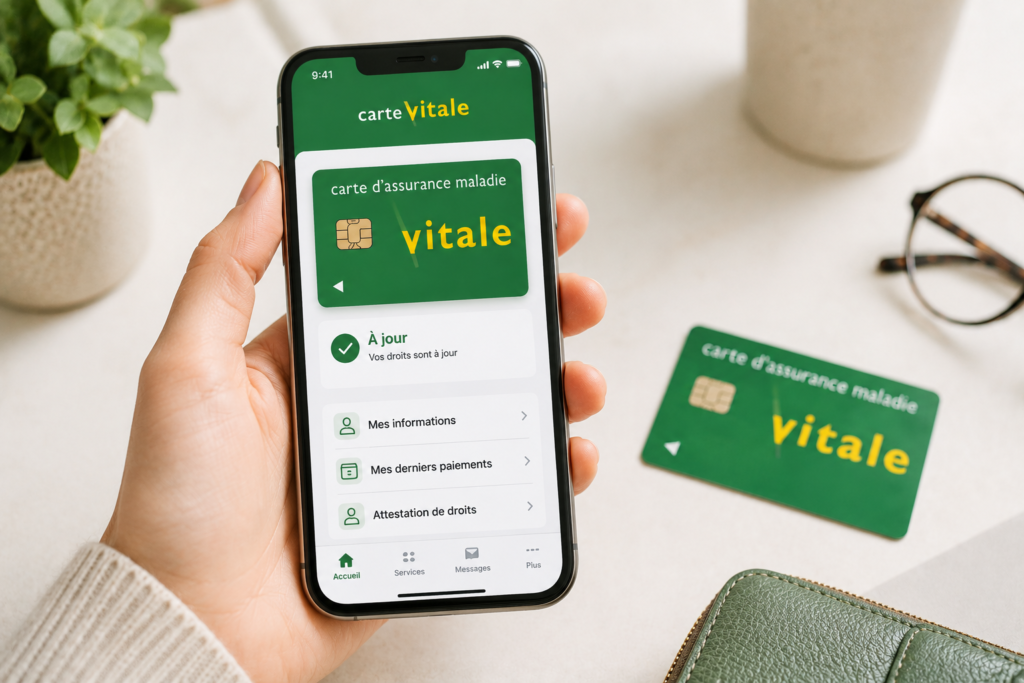
France now also has the appli carte Vitale — essentially a digital version of the Carte Vitale available on a compatible smartphone.
It can be used with participating healthcare professionals in place of the physical card and provides access to the same core services, with additional digital functionality.
One advantage is that information in the app is kept up to date automatically when the app is opened with an internet connection, rather than requiring the physical-card update process.
Can English-Speaking Foreign Residents Use the Digital Carte Vitale?
Potentially yes — but this is where the detail matters.
There are currently two activation routes.
People who have an eligible French electronic identity card can activate the app through France Identité.
There is also a video identity-verification route for people who do not use France Identité, provided they meet the eligibility requirements.
However, the identity documents accepted for video activation are currently limited. Assurance Maladie lists certain European identity cards, a French passport and a French-issued residence permit among the accepted documents.
This means that not every foreign resident will necessarily be able to activate the digital Carte Vitale using their foreign passport.
For example, having a British or American passport alone should not be assumed to make you eligible for the current video activation route.
This is exactly the kind of detail worth checking against current Assurance Maladie guidance because digital access is evolving.
Should I Get Rid of My Physical Carte Vitale Once I Have the App?
No.
Keep it.
The digital Carte Vitale is being adopted progressively by healthcare professionals, and not every doctor, pharmacy or healthcare establishment will necessarily be equipped to accept it yet.
Assurance Maladie specifically recommends continuing to carry your physical Carte Vitale for this reason.
For the moment, I would think of the app as a very useful additional way of presenting your Carte Vitale, rather than a reason to put the physical card permanently in a drawer.
Is the Digital Carte Vitale the Same as the Ameli App?
No.
This is another easy source of confusion.
The Compte ameli app allows you to manage aspects of your Assurance Maladie account — checking reimbursements, accessing documents and carrying out administrative procedures.
The appli carte Vitale is the digital version of your Carte Vitale.
And Mon espace santé is something different again.
Three digital tools.
Three different purposes.
If you’re new to the French system, being confused by all of this is entirely understandable.
Beware of Carte Vitale Scams
This deserves highlighting because Carte Vitale scams are common enough for Assurance Maladie to issue specific warnings.
You may receive a text message, email or phone call telling you:
Your Carte Vitale is expiring.
You need a new Carte Vitale.
You must pay postage for your replacement card.
You need to order a “Carte Vitale 2”.
Be extremely cautious.
Assurance Maladie states clearly that obtaining, updating or replacing a Carte Vitale through the official process is free, as is downloading the official Carte Vitale app.
It has specifically warned about fraudulent websites and messages requesting payment or personal information for supposed Carte Vitale renewals.
Never click automatically because a message happens to contain the Ameli logo.
If you’re concerned about your Carte Vitale, go independently to your official ameli account rather than following a link in an unsolicited message.
My Carte Vitale Has an Old Photo — Do I Need a New One?
Not simply because the photograph is old.
Likewise, Assurance Maladie has warned about fraudulent messages encouraging people to order supposed new versions such as a “Carte Vitale 2”.
If your existing card remains valid and functional, don’t replace it simply because an unsolicited message tells you there is a new version you need to buy.
If in doubt, check directly with Assurance Maladie.
Why Has My Carte Vitale Been Rejected?
There can be several reasons.
The card itself may have a technical problem.
It may need updating.
There may have been a change to your healthcare rights or administrative situation.
Or there may simply be a problem with the healthcare professional’s card reader or transmission system.
A rejected Carte Vitale does not automatically mean you have lost your healthcare rights.
This is one of those moments when people understandably panic.
Don’t immediately jump from:
“The machine won’t accept my card”
to:
“I’ve been thrown out of the French healthcare system.”
Check your ameli account and your attestation de droits. If necessary, contact your caisse to find out what is happening.
What If My Name or Personal Details Are Wrong?
Don’t ignore discrepancies.
If the information held by Assurance Maladie is incorrect, contact your caisse and provide whatever supporting documentation is required to have the underlying record corrected.
Once the change has been processed, you may need to update or replace your physical Carte Vitale depending on the change.
Your Carte Vitale should reflect the information held within your health insurance record.
Do I Need to Renew My Carte Vitale Every Year?
No — and this is an important distinction.
You should update your Carte Vitale regularly.
That does not mean you need to order a brand-new card every year.
If someone tells you your Carte Vitale is about to “expire” and you must pay to renew it, treat that message with suspicion.
Updating and replacing are two very different things.

Five Carte Vitale Habits That Make Life Easier
After helping people navigate French healthcare, these are the habits I think are genuinely worth adopting.
Take your Carte Vitale to healthcare appointments.
It sounds obvious, but it is remarkably easy to leave it in another handbag.
Keep an attestation de droits accessible.
It’s your useful backup when the physical card isn’t available.
Update your physical Carte Vitale at least once a year and after important changes.
It takes very little time.
Check your ameli account.
Don’t wait until you’re standing at a pharmacy counter to discover there is an administrative problem.
Never pay someone simply to “renew” your Carte Vitale.
Use official Assurance Maladie channels.
Carte Vitale: The Questions People Ask Me Most
Does a Carte Vitale mean healthcare is free?
No. It facilitates the processing of your French health insurance rights and reimbursements. Depending on the care and your circumstances, you may still have costs to pay.
Is my mutuelle on my Carte Vitale?
Your complementary insurer may be linked electronically to the Assurance Maladie reimbursement process, but your Carte Vitale and your mutuelle are not the same thing.
Can I see a doctor without a Carte Vitale?
Not having the physical card with you does not, by itself, remove your healthcare rights. Alternative administrative and reimbursement procedures may be necessary.
Can I use my partner’s Carte Vitale?
No. A Carte Vitale is personal.
Do I have to be French to get one?
No. Eligible foreign residents registered with the French health insurance system can have a Carte Vitale.
Does it contain my entire medical record?
No. Don’t confuse the Carte Vitale with your wider digital health information and Mon espace santé.
Do I need to renew it every year?
No. You should update it regularly, but that is not the same as replacing it annually.
Where can I update it?
Most pharmacies have facilities for updating a physical Carte Vitale.
How much does a Carte Vitale cost?
Nothing. Ordering, replacing and updating it through official channels is free.
Should I use the digital Carte Vitale?
If you’re eligible, it can be useful, but keep your physical card because adoption by healthcare professionals is still progressive.
Hello Santé — In Closing
The Carte Vitale is one of the most important pieces of the French healthcare puzzle, but it isn’t the whole puzzle.
It doesn’t mean all healthcare is free.
It isn’t your mutuelle.
It isn’t an identity card.
And it isn’t your complete medical record.
What it does is connect you efficiently to the administrative side of your French health insurance rights and make the reimbursement process considerably easier.
My biggest piece of advice?
Don’t wait until something goes wrong to understand it.
Know where your card is. Keep it updated. Have access to your attestation de droits. Check that your mutuelle is correctly connected where appropriate. And if something doesn’t look right in your ameli account, investigate it before you urgently need healthcare.
For English speakers living in France, it’s often these apparently small administrative details that create the most stress.
And that is exactly where a little healthcare handholding can make all the difference.