
REAL LIFE EXPERIENCES
Jeannie’s experience
In Hello Santé’s Real Life Experiences series, people share what navigating healthcare in France was like for them. In this story, Jeannie Clark takes us through her preventive health check, from receiving an invitation to finding out what her results meant.
Can you have a health check in France when you feel well? Yes. The examen de prévention en santé gives eligible people a chance to talk about their health and any concerns before they become pressing problems.
Jeannie Clark received an invitation to attend her local Centre d’Examens de Santé. She shared what happened at her appointment and why she was glad she went.
What is a preventive health check in France?
The examen de prévention en santé, or EPS, is a preventive health check offered through Assurance Maladie. It is tailored to your medical history and circumstances, so the questions and tests may differ from person to person.
Assurance Maladie says the check is available to people aged 16 and over who are covered by Assurance Maladie. It is fully covered, with no payment required upfront.
Who gets invited for a health check, and when?
Your local health insurance office, the CPAM, may invite you to book a check. Jeannie’s invitation arrived by email:
“I recently received an email inviting me to attend my Department’s Centre d’Examens de Santé for a preventative health check. I accepted the invitation, and a month later received an appointment.”
There is no fixed birthday or timetable when everyone receives an invitation. The check is available to eligible people aged 16 and over, with priority given to those who have less regular contact with healthcare or make less use of preventive services. Service Public also lists groups who may be given priority, including jobseekers and some students and retirees.
You do not need to wait for an invitation. If you are interested, you can contact a nearby Centre d’Examens de Santé yourself.
How did Jeannie prepare?
Jeannie confirmed her appointment by phone and was asked to bring details of her medication and recent medical results. Before the visit, she filled in a questionnaire about her health history:
“Prior to the actual check up I had to fill in an online form giving full details of my relevant medical history – as well as giving me the opportunity to say if there was anything I was concerned about. The form was duly filled in, and I was asked to create a pass code of four numbers in order to be able to share it with the health professionals who would be seeing me – and to keep that number safe.”
Jeannie was also asked to arrive fasting. Follow the instructions from your own centre, and contact them beforehand if you have questions about fasting or medication.
One of Jeannie’s tips is to keep your questionnaire code handy. She forgot hers and had to complete the form again on paper.
.

What happens during a preventive health check?
At reception, Jeannie showed her Carte de Séjour and Carte Vitale. She then saw several members of the team:
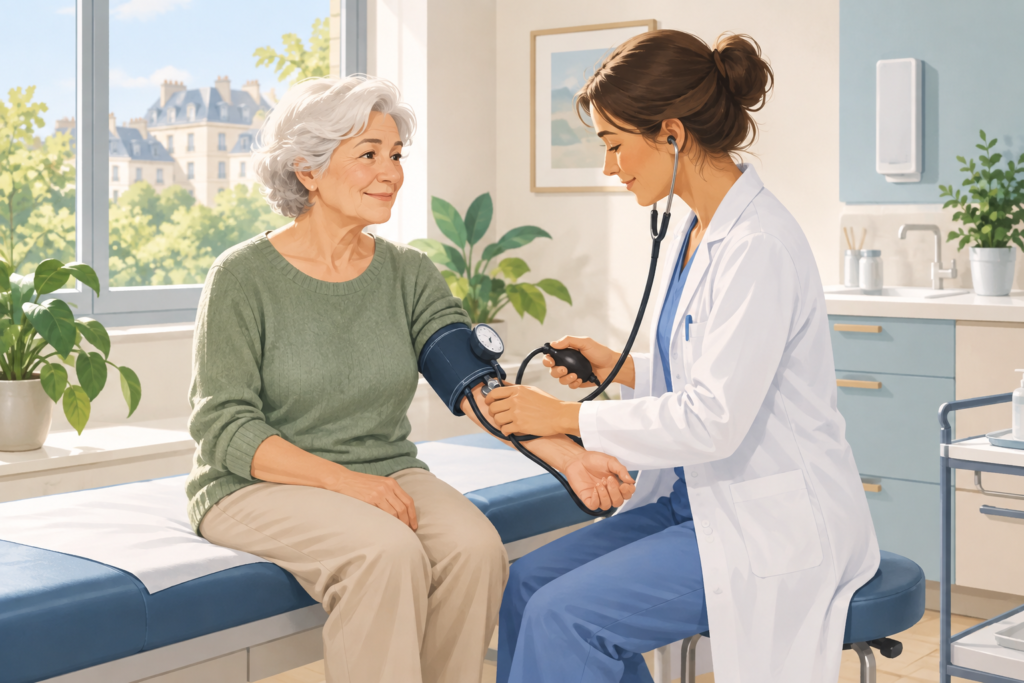
“From then on the system was extremely efficient. A nurse came to take me for blood and urine tests. Then a brief return to the chair before being whisked off to another examination room for height, weight and blood pressure (measured on both arms for some reason!).”
The team also asked about her exercise, balance and support at home:
“They were also very concerned that I was not isolated, and that I had regular contact with people. They wanted to know if I had anyone who would be able to care for me if I had an accident.”
Jeannie later saw a doctor to review her medical history, have an examination and discuss healthy habits. Her visit took a couple of hours. What happens at your appointment will depend on your own health and circumstances.
For Jeannie, the value was having time to look ahead:
“Whereas most of us only go to see our doctor once we have an issue, this is very much geared to looking out for future problems and being able to perhaps prevent something from developing.”
What did Jeannie learn from her results?
Jeannie received her full report a week after the appointment. It showed something she wanted to follow up:
“I received my full report a week later, and discovered that my LDL cholesterol (the ‘bad’ cholesterol) is high. I’m going to see if I can reduce it by eating lower fat Greek yoghourt and semi-skimmed milk then have another blood test in three months. If I can’t reduce it I’ll have to start taking statins – but without this check up I would never have found out – so another reason to be grateful.”
That is Jeannie’s personal plan. If a result concerns you, discuss what it means and the next steps for you with a healthcare professional.

How do you book a preventive health check in France?
As Jeannie discovered, an invitation is only one way to arrange an appointment:
“Although I only found out about this preventative health check when an email arrived, it is possible to phone your local Centre d’Examens de Santé to ask for an appointment”
The Assurance Maladie guide to preventive health checks explains how to find a centre near you.
If making the call or handling the paperwork in French feels difficult, contact Hello Santé. We help English speakers navigate healthcare appointments and administration in France.
Jeannie’s final impression captures why she wanted to share her experience:
“I left feeling very reassured.”
Thank you to Jeannie Clark for sharing her experience. Appointment preparation, tests and the timing of results may vary