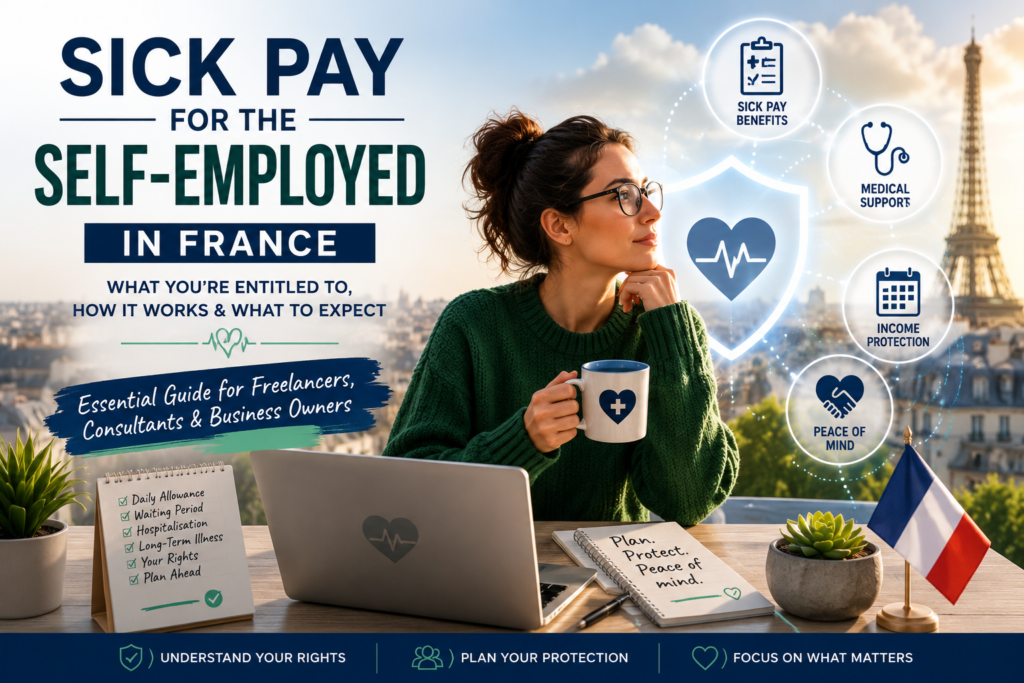
If you’re self-employed in France, one of the biggest questions you should ask yourself is:
“What happens if I can’t work because I’m sick?”
Many entrepreneurs assume that because they work for themselves, there is no financial support available if illness prevents them from working. Fortunately, that’s no longer true.
Today, most self-employed workers in France—including auto-entrepreneurs (micro-entrepreneurs), freelancers, consultants, tradespeople, and many liberal professionals—can receive daily sickness benefits (indemnités journalières) from the French social security system when they are unable to work due to illness or injury.
However, the system is far from straightforward.
This guide explains:
- Who qualifies for sick pay in France
- How much you can receive
- How the payment is calculated
- What auto-entrepreneurs need to know
- The common mistakes that can cost you money
- Why many business owners still need additional protection
- Useful official government resources
Do Self-Employed People Get Sick Pay in France?
Yes.
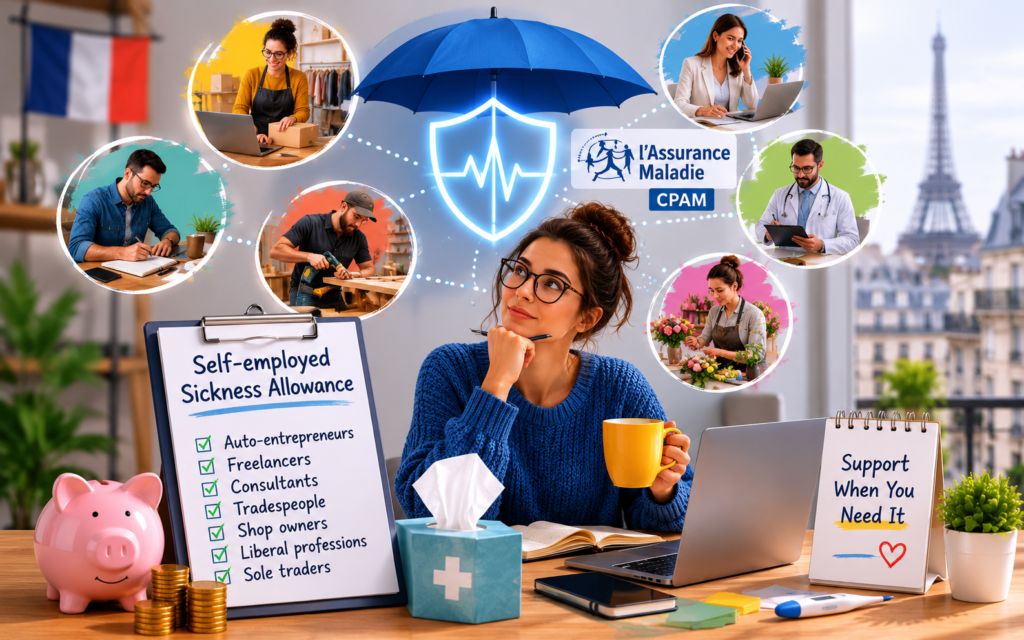
Most self-employed workers affiliated with the French social security system can receive daily sickness allowances (Indemnités Journalières or IJ) when they are medically signed off work. These payments are administered by the CPAM (Caisse Primaire d’Assurance Maladie).
This applies to:
- Auto-entrepreneurs (micro-entrepreneurs)
- Freelancers
- Consultants
- Tradespeople
- Shop owners
- Many liberal professions
- Sole traders (entrepreneurs individuels)
The benefits are designed to partially replace lost income while you are unable to work. They are not intended to cover 100% of your earnings.
Who Qualifies for Sick Pay?
Most self-employed workers in France can receive daily sickness benefits (Indemnités Journalières or IJ) if they are unable to work due to illness or injury.
To qualify, you must generally:
- Be affiliated with the French social security system through your self-employed activity.
- Have been affiliated in your current self-employed activity for at least 12 months.
- Obtain an official arrêt de travail (medical certificate) from a doctor.
- Meet the applicable income conditions.
This applies to many self-employed workers, including auto-entrepreneurs (micro-entrepreneurs), freelancers, consultants, tradespeople, shop owners and many liberal professions.
However, entitlement rules and payment levels vary depending on your professional category, so it is always worth checking your specific situation with CPAM or your professional body.
How Much Sick Pay Will You Receive?
This is where many self-employed people get a surprise.
Your daily sickness benefit is based on your average declared professional income, not necessarily the turnover your business generates.
For many self-employed workers, the calculation is based on your average annual income over the previous years and is subject to minimum and maximum thresholds set by the French social security system.
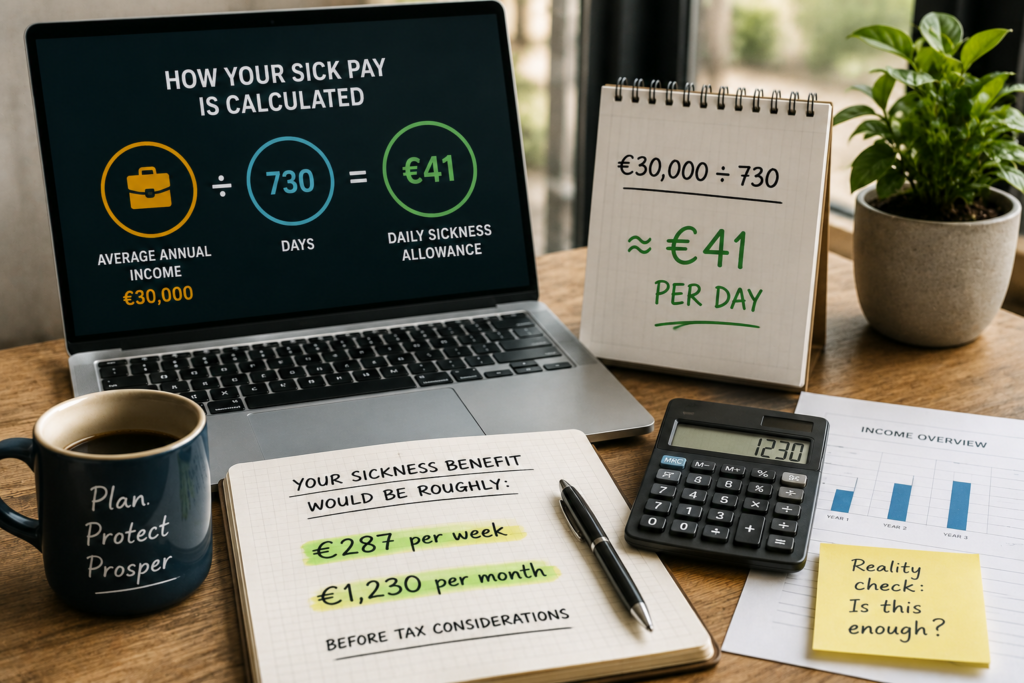
For example, if your average declared professional income is €30,000 per year:
€30,000 ÷ 730 = approximately €41 per day
This would equate to roughly:
- €287 per week
- €1,230 per month
before tax considerations.
However, benefits are capped. For artisans, commerçants and many micro-entrepreneurs, the maximum daily sickness allowance in 2026 is €65.84 gross per day.
For auto-entrepreneurs, the calculation is based on taxable income after the standard micro-enterprise allowance has been applied to your turnover. This means your entitlement may be significantly lower than you expect if you only look at your gross turnover figures.
For many business owners, statutory sick pay provides only partial income replacement rather than a full replacement of earnings.
A Warning for Low-Income Businesses
The amount you receive depends on your declared income.
If your average annual income falls below certain minimum thresholds, your daily sickness allowance may be significantly reduced or, in some cases, unavailable altogether.
This is particularly important for micro-entrepreneurs and part-time business owners who declare relatively low levels of income.
Before relying on state support, it is worth checking your current entitlement directly through your Ameli account or CPAM.
The Auto-Entrepreneur Reality
Many English-speaking business owners in France operate under the micro-entrepreneur system.
The challenge is that your sickness benefits are based on your declared taxable income, not simply your turnover.
After the relevant micro-enterprise allowance is applied, many auto-entrepreneurs discover their effective income is much lower than expected for benefit calculations.
As a result:
- Low turnover often means very low sick pay.
- Very low declared income may mean no meaningful compensation.
- The benefit may be insufficient to cover rent, mortgages, and business expenses.
This is one of the most overlooked risks of running a business in France.
Is There a Waiting Period?
Yes.
In most cases, self-employed workers do not receive sickness benefits immediately.
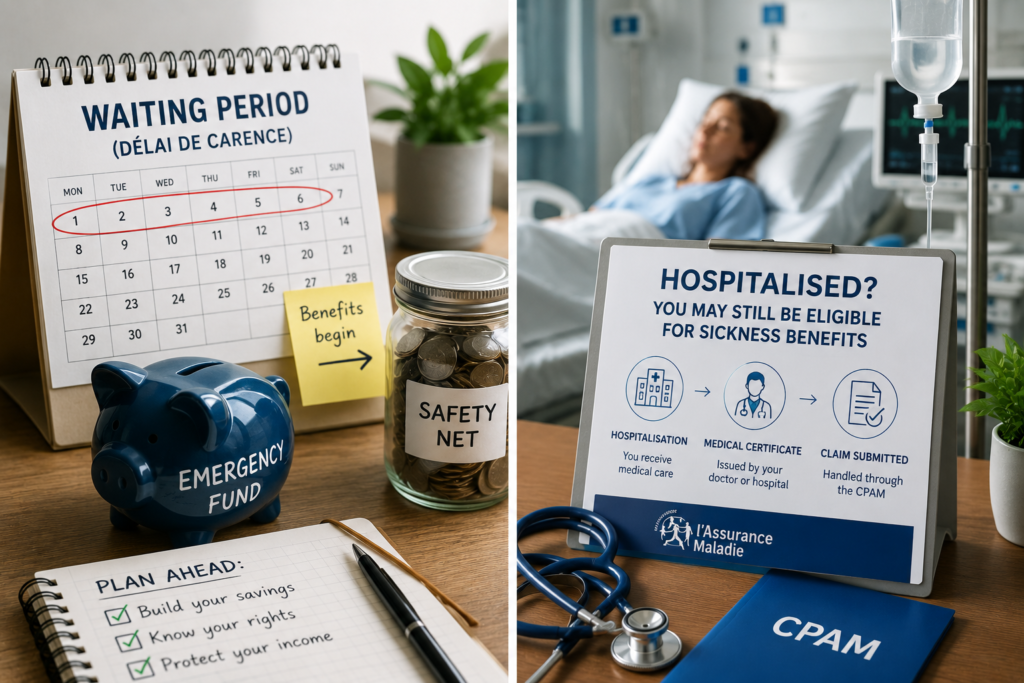
A waiting period (known as a délai de carence) generally applies, meaning payments usually begin from the fourth day of an approved sick leave period.
Because benefits are not paid straight away, it is important to maintain an emergency fund and avoid relying solely on state support during the early days of illness.
Certain long-term medical conditions may be subject to different rules.
What Happens If You're Hospitalised?
Hospitalisation may qualify you for sickness benefits if an official arrêt de travail has been issued and you meet the normal eligibility conditions.
Your doctor or hospital will provide the necessary medical documentation, and your claim will be processed through the French health insurance system.
As with standard sickness leave, the amount paid depends on your professional status, declared income and entitlement conditions.
How Do You Claim Sick Pay?
The process is relatively simple.
Step 1
Visit your doctor.
Step 2
Obtain an official arrêt de travail.
Step 3
Ensure the documentation is transmitted to your CPAM.
In many cases doctors now submit information electronically. If paper forms are issued, they must generally be sent within 48 hours.
Step 4
Monitor your Ameli account for payment updates.
Benefits are typically paid directly by the French health insurance system.
Can You Continue Working While Claiming Sick Pay?
Generally, no.
Sickness benefits are intended for periods when you are medically unable to work.
Continuing business activities during a period of certified sickness leave can create serious problems and potentially lead to repayment demands. CPAM can carry out checks during a sick leave period.
What About Long-Term Illness?
If you suffer from a recognised long-term illness (Affection de Longue Durée or ALD), different rules may apply.
For some ALD-related absences, the standard waiting period only applies to the first sick leave connected to that condition over a three-year period.
Entitlement periods, payment rules and administrative procedures can vary depending on your professional category and the nature of your condition.
If you have a chronic or serious illness, contact CPAM directly to understand the support available in your specific circumstances.
If you have a chronic or serious medical condition, seek advice directly from CPAM regarding your specific situation.

Why Many Self-Employed People Take Out Additional Income Protection
Here’s the uncomfortable truth:
For many entrepreneurs, the state system is only a safety net.
This is especially true for auto-entrepreneurs and freelancers whose declared income may be substantially lower than their actual business turnover. In these situations, state sickness benefits can fall well short of covering ongoing personal and business expenses.
Even if you qualify, the payment may be far below your normal income.
Many business owners therefore purchase:
- Prévoyance insurance
- Income protection insurance
- Professional protection policies
These policies can supplement state benefits and help cover:
- Mortgage payments
- Household bills
- Business overheads
- Family expenses
If your business depends entirely on your ability to work, additional cover is worth considering.
Common Mistakes Self-Employed People Make
Assuming They Have No Cover
Many entrepreneurs wrongly believe self-employed workers receive nothing.
Not Understanding Their Income Basis
Benefits are linked to declared income, not what you think you earn.
Missing Deadlines
Medical certificates generally need to be submitted promptly to CPAM.
Having No Emergency Fund
Even with benefits, payments rarely replace full income.
Ignoring Insurance Options
Many discover too late that statutory payments are insufficient.
Useful Official Resources
French Health Insurance (Ameli)
Official information on sick leave and self-employed benefits:
Self-employed sick leave guidance:
Daily allowance information:
https://www.ameli.fr/assure/remboursements/indemnites-journalieres-maladie-maternite-paternite
Service Public
France’s official government information portal:
Business and social protection information:
https://entreprendre.service-public.fr
URSSAF
Information on social protection rights for self-employed workers:

Final Thoughts
France offers considerably more protection for self-employed workers than many newcomers expect. If you’re registered correctly and paying into the system, you may be entitled to sickness benefits when illness prevents you from working.
However, the level of support often comes as a surprise.
For many freelancers, consultants and auto-entrepreneurs, state sick pay provides only a partial income replacement. Understanding how the system works—and planning accordingly—can make the difference between a temporary setback and a financial crisis.
If you’re self-employed in France, don’t wait until you’re ill to find out what you’re entitled to. Check your Ameli account, understand your declared income position, and make sure you have a realistic backup plan in place.
Your future self will thank you.
Disclaimer: Social security rules, thresholds and benefit rates are updated regularly. The information in this guide is intended as general guidance and should not be considered legal, financial or tax advice. Always check the latest information with Ameli, CPAM or a qualified professional adviser.
Need More Help Navigating Healthcare in France?
Understanding sick pay is just one part of navigating the French healthcare system as a self-employed professional. From health insurance and reimbursements to specialist care, preventative health, and wellbeing, there are plenty of rules and processes that can be difficult to understand—especially in a second language.
At Hello Santé, we help English-speaking residents of France make sense of healthcare with clear, practical, and easy-to-understand information. Whether you’re a freelancer, entrepreneur, retiree, or expat family, our goal is to help you make informed decisions about your health and wellbeing.
Explore more guides, expert advice, and healthcare resources at Hello Santé
Because understanding your healthcare rights shouldn’t be complicated.